
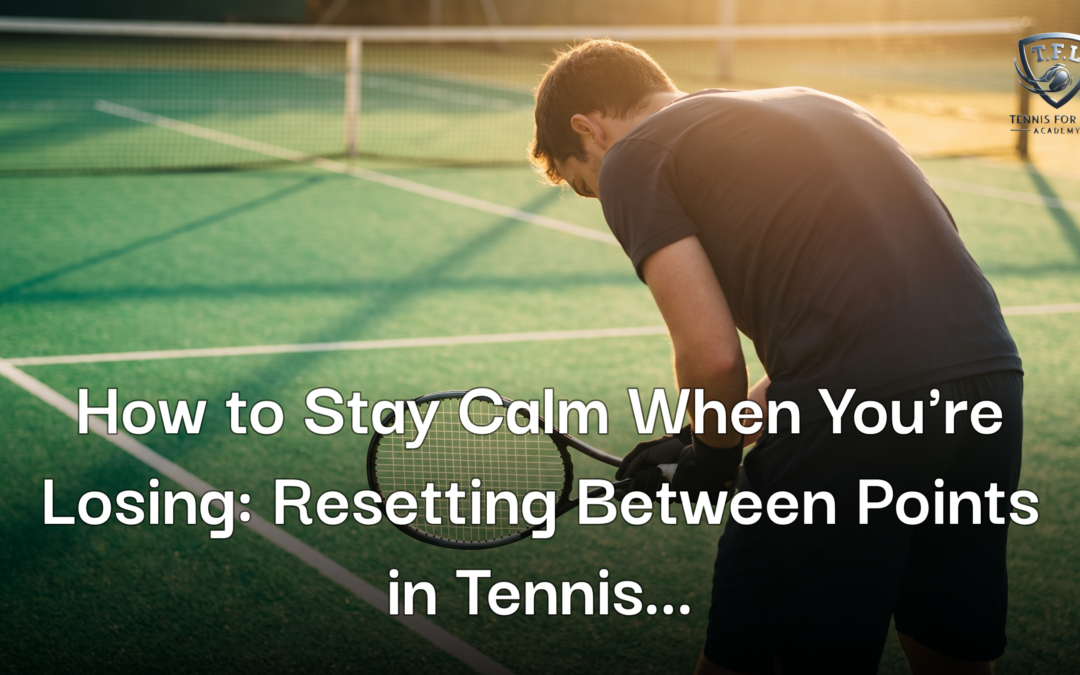
The Match Is Already Slipping Away
You drop your serve. Then you dump a routine forehand into the net. Then the one you were sure was in gets called out. Before you know it, you're down a break and a half, your grip is tighter than it should be, and every shot feels like it needs to be a winner to claw things back.
Sound familiar? Most club players have been there. The frustrating part is that the tennis itself often isn't the problem at that point. The problem is what's happening in the 20 to 25 seconds between each point, and most players waste every single one of them.
The Statistic That Should Change How You Think About Losing
Roger Federer, across 1,500 matches and 20 Grand Slam titles, won approximately 54% of the points he played. That means the greatest player of his generation lost nearly half of all points. Every match, every tournament, every final.
That's worth sitting with.
If Federer lost close to half his points and still dominated the sport for two decades, then losing points is not the problem. How quickly you move on from them is.
This is where dealing with losing in tennis becomes a skill rather than a character flaw.
Composure under adversity, not perfection, is what separates players who compete well from players who unravel. Sports psychologists have been saying this for years, and the data backs it up.
Where Matches Are Actually Decided
Here's a number that surprises most players: 75 to 85% of a tennis match is spent between points, not during actual play. The rallies, the serves, the volleys – all of that accounts for a fraction of your time on court. The rest is walking back to the baseline, adjusting your strings, bouncing on your toes, and talking to yourself.
On the ATP Tour, the rules allow 25 seconds between points. At club level, the ITF rule is closer to 20 seconds. Either way, that window is yours to use deliberately. Most players use it to replay the last error in their head, tighten their shoulders, and walk into the next point already half-defeated.
The players who handle pressure in tennis well do something different with those seconds. They have a routine.
The Between-Point Routine: Four Steps That Actually Work
A between-point routine popularised in sports psychology circles and broken down clearly in Meike Babel's coaching work follows four stages. They're simple. They're not easy to do under pressure until you've practised them.
- Response – control your body language immediately: Right after the point ends, your body language sends a signal to your brain. Slumped shoulders and a dropped head tell your nervous system you're beaten. Standing upright, taking a breath, and walking with deliberate pace tells it something different. This isn't about faking confidence. It's about not actively making things worse with your own posture.
- Relax – release tension fast: Muscle tension under pressure concentrates in the wrists and shoulders. That's exactly where you need freedom to swing. A few targeted actions help here: shake out your wrist, roll your shoulders back, take one slow exhale. Not three minutes of yoga. Ten seconds of conscious release.
- Refocus – reset your thoughts: This is where self-talk matters. More on this below, but the short version is: neutral beats positive when you're under pressure. "Next ball" is more useful than "come on, you've got this" when you're down 4-1 in the second.
- Ready – commit fully to the next point: Before you step up to serve or return, you need one clear tactical intention. Not a vague hope. A specific decision: "I'm going wide on the deuce side" or "I'm taking the first short ball and coming in." Commit to it. The point hasn't happened yet.
Neutral Self-Talk vs. Forced Positivity
This one catches people off guard. The instinct when you're losing is to pump yourself up, to generate enthusiasm you don't actually feel. Sports psychologist Dr. Patrick Cohn, who has worked in performance psychology for over 35 years, recommends neutral self-talk phrases specifically because they de-escalate emotional intensity rather than trying to override it.
Phrases like "next ball," "compete here," or just "refocus" work because they redirect attention without demanding a feeling you can't manufacture on demand. Forced positivity when you're genuinely frustrated often backfires – it creates a gap between what you're saying and what you actually feel, and that gap is exhausting to maintain mid-match.
Neutral is not negative. It's just clear. This approach to tennis confidence tips sidesteps the trap of trying to feel something you don't, and instead focuses on what you can actually control.
The Pause-Reset-Refocus Sequence for Momentum Spirals
Losing serve tends to trigger something specific in club players: a momentum spiral. One bad game becomes an expectation of the next bad game. The internal monologue shifts from "play the point" to "don't lose again," and that shift is almost always fatal to your level.
Sports psychologists describe a three-step sequence to interrupt this pattern before it takes hold.
- Pause: Take 1 to 2 slow, deliberate breaths before you do anything else. Not a gasp. A real exhale.
- Reset: Use a physical or verbal cue to mark the break from the last point. Some players press a fist to their thigh. Some say "stop" quietly. Some simply switch their racket to their non-dominant hand for a few seconds. The specific cue matters less than having one you've practised.
- Refocus: Ask yourself one question: "What do I want to do differently on this next point?" Not "why did I miss that?" A forward-facing question, not a backward-facing one.
The sources vary on whether verbal cues, physical cues, or breathing work best – and honestly, that's because different players respond differently. Try all three in practice and find out which one actually interrupts your spiral. Then own it.
Keep Moving Between Points
One thing that gets overlooked in resetting between points is physical pacing. When nerves hit, players tend to either rush – playing the next point before they've reset – or go completely still, which lets tension settle into the legs.
Neither is great. Staying lightly on your toes, taking small steps, keeping the body moving at a low level between points prevents the leg tension that nerves commonly cause. It also slows the match down perceptually. You stop playing in a fog.
Deliberately walking to the baseline rather than trudging or sprinting is a physical act that signals to your brain: I'm in control of this pace.
These Skills Need to Be Practised, Not Just Read About
Here's the honest part. Reading this post won't change anything by itself. Reset routines have to be rehearsed under low-stress conditions before they hold up under match pressure. That's not a caveat – it's just how skill acquisition works.
The drill: "Pressure point" practice
Next time you're doing a practice set, agree with your hitting partner that every time either of you loses two consecutive points, you must complete your full between-point routine before the next serve – visibly, out loud if needed. Walk back, shake out the wrist, say your reset cue, state your tactical intention for the next point. It feels awkward at first. That's fine. Awkward in practice means automatic in matches.
Do this for four or five practice sets and the routine starts to become reflex. That's the goal.
A short checklist for your next session:
- Pick one reset cue (verbal, physical, or breath-based) and use it every single point, not just when you're losing
- After each point, stand upright before you do anything else
- Before each serve or return, name one tactical intention out loud or in your head
- If you feel yourself rushing, take one extra breath and walk two steps slower than feels natural
Losing Points Is Part of the Game
Mental toughness in tennis isn't some fixed personality trait you either have or don't. It's a set of practised responses. Federer lost nearly half his points across a career that produced 20 Grand Slams. A poor start doesn't determine where a match ends. What happens in those 20 to 25 seconds between each point, repeated dozens of times across a match, is where the real game is played.
You have the time. Use it deliberately.
If you want to work on the mental side of your game alongside the technical, we run group and individual sessions at TFL Tennis Academy across Parkhurst, Fourways, Rivonia, and Midrand. Come try a session – book a free trial lesson and see what a structured practice environment does for how you compete.