
The String Bed Is Doing More Than You Think
Last week a player came off court frustrated. He'd just bought a new racket, strung it with a stiff polyester at 58 lbs because "that's what the pros use," and couldn't understand why his arm was killing him and the ball kept flying long. He's a 3.5-level club player who hits maybe three times a week. The racket wasn't the problem. The string choice was.
This comes up constantly. String is the only part of your racket that actually contacts the ball, and most players either copy what they saw on TV or just take whatever the stringer puts in. This post is about making a deliberate choice – what nylon vs polyester tennis strings actually feel like in your hand, who benefits from each, and how tension and gauge change the picture.
What Nylon and Polyester Actually Feel Like
Feel this in your mind: you hit a ball with a nylon multifilament and it's almost springy. The string bed gives a little, there's a soft, cushioned sensation at contact, and the ball seems to sit on the strings for a fraction longer. It's forgiving. Off-center hits don't punish you as much.
Now hit the same ball with a polyester monofilament. Firmer. Boardier. The feedback is more immediate and slightly harsh. There's less elasticity, which means the ball leaves the string bed faster and with less natural power. If your swing speed is high, that's fine – you're generating your own pace and the firmness gives you the control and spin bite you want. If your swing speed is moderate, you're fighting the string.
That's the core of it. Nylon (multifilament or synthetic gut) is elastic, comfortable, and arm-friendly. Polyester is firm, durable, and built for players who swing hard. Neither is universally better. They're tools for different jobs (USTA Equipment Guide).
Who Should Use Nylon
Most recreational players. Full stop.
If you play two or three times a week, you're not breaking strings every fortnight, and your priority is enjoying the game rather than hitting 3,000 rpm topspin, a quality nylon multifilament is almost certainly the right call. The string bed is more comfortable, it generates its own power, and it absorbs vibration at contact rather than transmitting it up your arm.
Doubles players and net-rushers especially benefit here. You're not relying on heavy topspin to keep the ball in – you're redirecting pace, hitting angles, and punching volleys. Nylon handles all of that well.
Beginners fit squarely in this category too. Babolat's multifilament range, for example, is specifically designed to absorb unwanted vibration from ball impact – which matters when you're still developing consistent contact (Babolat String Guide). You don't need a stiff string bed fighting your developing technique.
Who Should Use Polyester
Advanced baseliners with fast, modern swings. Players who break strings regularly. Anyone chasing heavy topspin as a tactical weapon.
Polyester strings are firm and resilient, designed for hard hitters who use fast swing speeds to apply heavy topspin for control (USTA). The trade-off is that they're considered underpowered – you have to generate your own pace. That's fine at a high level. At a club level, it often means shorter rallies and a tired arm.
There's also a spin argument. One widely cited test comparing nylon vs polyester tennis strings found polyester generates roughly 20% more spin than nylon on average – worth noting, though that figure comes from a community-shared test rather than a peer-reviewed study, so treat it as directionally useful rather than definitive. The mechanism is real regardless: polyester's lower friction coefficient lets the strings snap back faster after contact, which increases topspin.
Textured polyester strings push this further. All spin-specific textured strings are made from polyester – the surface geometry adds bite that nylon simply can't replicate (Royal Glenora Club).
The Arm Health Question
If you're dealing with elbow or shoulder pain, see a physio first. Strings are not a treatment, and no string choice fixes an injury.
That said, from a pure equipment standpoint: polyester is harder on the arm than nylon, and that's well established (Royal Glenora Club). The stiffness of a polyester string bed transmits more shock at impact. If you're already managing arm issues, best strings for tennis elbow typically include a nylon multifilament at a slightly lower tension. But again – get the arm assessed first. Equipment adjustments are a secondary consideration, not a substitute for proper care.
Tension and Gauge: The Variables Nobody Talks About Enough
String type gets all the attention, but tennis string tension and gauge reshape the feel of any string significantly.
Tension is counterintuitive for most players. Higher tension gives more control; lower tension gives more power. The looser string bed deflects more on impact and stores more energy, which it returns to the ball. A tighter bed deflects less and gives you more precision but less natural pace (USTA). Start in the middle of your racket manufacturer's recommended range – if the frame says 55-60 lbs, start at 57 or 58 lbs – and adjust from there based on how the ball is behaving.
Gauge is the string's thickness. Thinner strings (1.05 mm to 1.20 mm) offer more feel and power because they deflect more and bite the ball better. Thicker strings (1.30 mm to 1.40 mm) are more durable and give slightly more control (Tennispro). If you're breaking strings often, go thicker before switching string type entirely. If you want more feel from your current setup, try dropping a gauge.
Hybrid Stringing: A Real Middle Ground
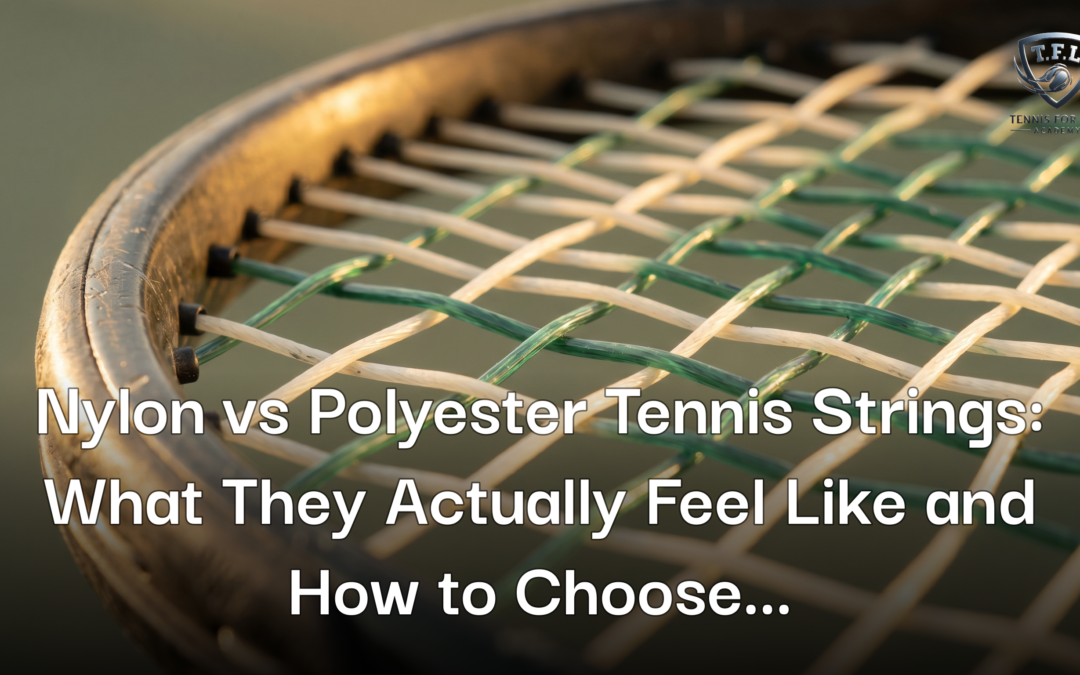
A hybrid tennis string setup means stringing the mains and crosses with different strings. At the pro level, the most common combination is natural gut in the mains and polyester in the crosses – you get the feel and arm comfort of gut with the durability and spin of poly (LTA String Guide). Natural gut is expensive and fragile, so it's not practical for most club players.
A more accessible version: nylon multifilament mains with polyester crosses. You get a softer, more comfortable feel from the mains (which contact the ball most), with added durability from the poly crosses. It's a reasonable option if you want something between a pure nylon and a pure poly setup, and it costs less than a full gut hybrid.
How Often Should You Actually Restring?
A common rule of thumb: restring as many times per year as you play per week. Play three times a week, restring three times a year. Most club players leave strings in far too long. Strings lose tension and elasticity gradually, so the racket you're playing with in month six feels nothing like it did when it was freshly strung – even if the strings haven't broken.
Dead strings lose their responsiveness and can actually contribute to arm strain because you start swinging harder to compensate. A fresh restring is one of the cheapest performance improvements available. How often to restring your tennis racket depends on your play frequency, but the rule above gives you a solid baseline.
If you're in Johannesburg and looking for a tennis racket restring, TFL can sort you out at any of our locations. The tennis restring cost South Africa varies depending on string choice, but it's a straightforward service and worth doing on a regular schedule rather than waiting for a string to snap.
A Quick Decision Framework
Before you book your next restring, think through these four things:
- Your level and swing speed: Fast, modern swing with heavy topspin? Polyester is worth trying. Moderate swing, recreational play? Start with nylon.
- Your arm health: Any elbow or shoulder issues, see a physio first. From an equipment angle, nylon multifilament at lower tension is the gentler choice.
- How often you break strings: If you're snapping strings every few weeks, a thicker gauge or polyester will last longer. If strings never break, durability isn't your constraint.
- What you want from the ball: More power and comfort? Nylon, lower tension. More control and spin? Polyester, mid-to-higher tension.
If you're still unsure, a hybrid setup is a sensible place to start – it gives you information about what you actually prefer without committing fully to either end of the spectrum.
Come Talk Strings at TFL
String choice is one of those things that's much easier to sort out in person. If you're not sure what's currently in your racket or whether it's still doing its job, bring it in. Our coaches at TFL Tennis Academy work with players across all levels at our Parkhurst, Fourways, Rivonia, and Midrand locations, and we're happy to have a look and point you in the right direction.
Book a free trial lesson and we can assess your game alongside your gear – sometimes the string change makes more difference than another hour of drilling.